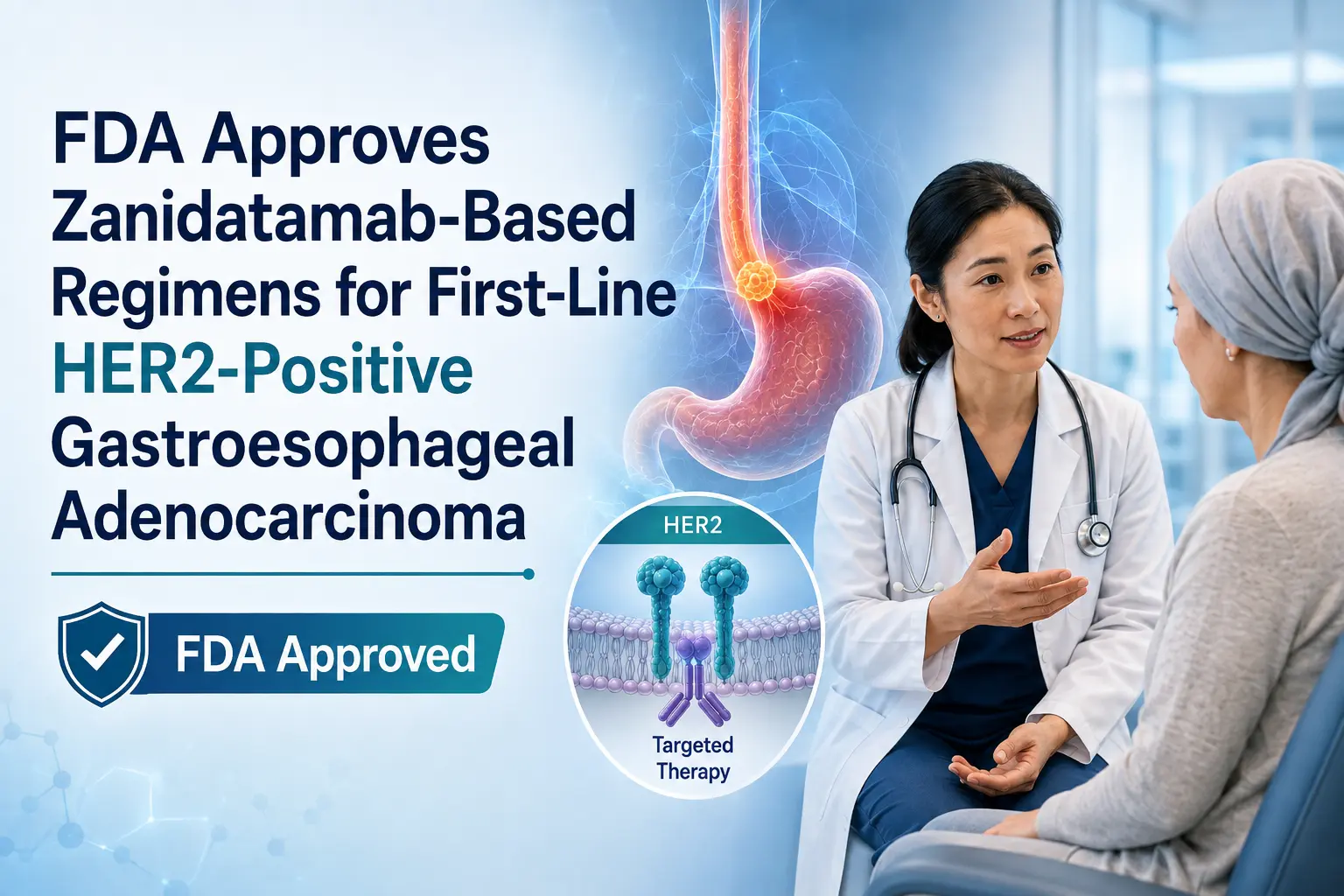
On August 25, 2026, the U.S. Food and Drug Administration (FDA) approved zanidatamab (Ziihera) in combination with fluoropyrimidine- and platinum-containing chemotherapy, with or without tislelizumab (Tevimbra), for the first-line treatment of adults with HER2-positive, unresectable locally advanced or metastatic gastric, gastroesophageal junction (GEJ), or esophageal adenocarcinoma. The approval provides an important new treatment option for patients with advanced HER2-positive gastroesophageal adenocarcinoma (GEA).
Understanding the approved use of zanidatamab-hrii injection in India, its role in HER2-positive gastroesophageal adenocarcinoma, and the clinical evidence supporting its use can help provide a clearer picture of this newer treatment option.
Importantly, the FDA approval allows treatment regardless of PD-L1 status, making HER2 status the key biomarker for selecting eligible patients for these Ziihera-based regimens.
HER2-Positive GEA: A Targetable Subtype
Cancers that develop in the stomach, gastroesophageal junction, and esophagus are referred to as gastroesophageal adenocarcinomas. Human epidermal growth factor receptor 2 (HER2), a protein important in cell proliferation and survival, is overexpressed by tumor cells in a subset of patients.
For this reason, HER2 testing is crucial when choosing a course of treatment. Depending on the treatment plan, patients whose tumors show HER2 IHC 3+ or IHC 2+/ISH-positive status may undergo Ziihera-based therapy under the new FDA approval. To find qualified patients, the FDA also authorized companion diagnostic tools.
Ziihera: Mechanism of Action
The HER2-targeted bispecific antibody zanidatamab (Ziihera) is made to attach to two distinct locations on the HER2 receptor.
Zanidatamab can disrupt HER2 signaling and encourage immune-mediated elimination of tumor cells that express HER2 by concurrently interacting with different HER2 epitopes. Zanidatamab’s dual-targeting strategy sets it apart from traditional HER2-directed therapy and serves as the foundation for its combination with immunotherapy and chemotherapy.
How Tislelizumab Complements HER2-Targeted Therapy
Tislelizumab (Tevimbra) is a PD-1 immune checkpoint inhibitor. By blocking the PD-1 pathway, it can help restore T-cell activity against cancer cells.
The Ziihera + tislelizumab + chemotherapy combination therefore brings together three complementary approaches:
-
- Zanidatamab: targets HER2 directly.
- Tislelizumab: activates antitumor immune responses by inhibiting PD-1 signaling.
- Chemotherapy: directly targets rapidly dividing cancer cells.
This combination is particularly notable because the FDA approval is not restricted by PD-L1 status in HER2-positive disease.
The Trial Behind the Approval : HERIZON-GEA-01
The Phase 3 HERIZON-GEA-01 trial, a randomized, open-label, international study assessing first-line therapy in patients with untreated, HER2-positive advanced gastroesophageal adenocarcinoma, provided support for the approval.
Three treatment groups were randomly assigned to the patients:
Chemotherapy plus trastuzumab,chemotherapy plus zanidatamab, and chemotherapy plus tislelizumab
The foundation of chemotherapy was either fluorouracil plus platinum treatment or CAPOX (capecitabine plus oxaliplatin).
Key Efficacy Results
The combination of zanidatamab + tislelizumab + chemotherapy demonstrated statistically significant improvements in both progression-free survival (PFS) and overall survival (OS) compared with trastuzumab + chemotherapy.
| Outcome | Ziihera + Tevimbra + Chemotherapy | Trastuzumab + Chemotherapy |
| Median PFS | 12.4 months | 8.1 months |
| PFS Hazard Ratio | 0.63 | — |
| Median OS | 26.4 months | 19.2 months |
| OS Hazard Ratio | 0.72 | — |
The combination reduced the risk of disease progression or death by approximately 37% and the risk of death by approximately 28% compared with the trastuzumab-based control regimen.
Zanidatamab + chemotherapy without tislelizumab also significantly improved PFS compared with trastuzumab + chemotherapy. In patients with HER2 IHC 3+ tumors, median PFS was 14.2 months versus 7.6 months, respectively
Conclusion
An important advancement in the first-line treatment of HER2-positive advanced gastroesophageal adenocarcinoma has been made with the FDA’s approval of Ziihera (zanidatamab-hrii) with chemotherapy, either with or without Tevimbra (tislelizumab-jsgr). The regimen showed significant improvements in progression-free and overall survival when compared to trastuzumab-based therapy, as supported by the HERIZON-GEA-01 trial.
For those researching zanidatamab-hrii injection in India, information about the medicine’s approved indications, HER2 testing requirements, and clinical trial evidence can help provide a clearer understanding of this treatment option and its potential access considerations.
By combining dual HER2 targeting, immune checkpoint inhibition, and chemotherapy, this treatment strategy offers a new approach to HER2-positive advanced GEA and expands the therapeutic landscape for patients with unresectable or metastatic disease.