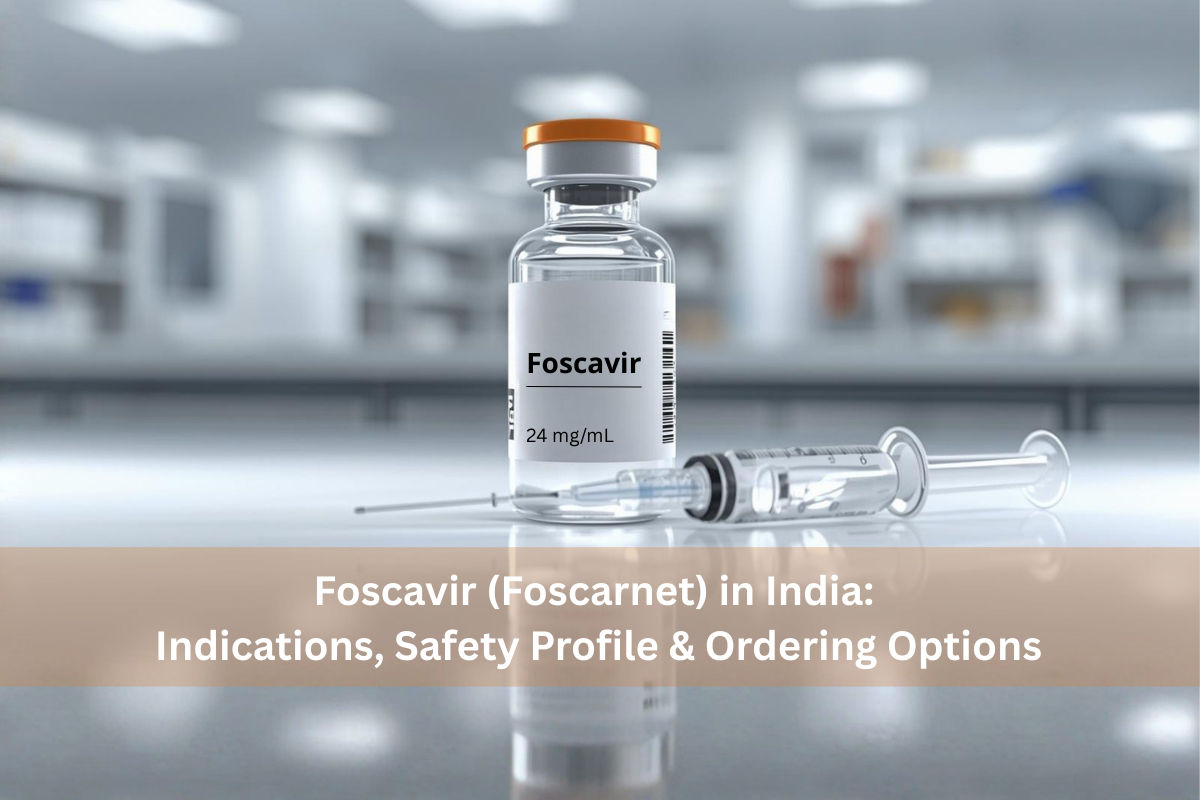

Foscavir (Foscarnet sodium) is an effective antiviral medication that doesn’t end with dosing but rather careful monitoring is needed. Let’s understand in which conditions Foscavir is used and what are the protocols one should follow while taking it.
For patients and caregivers researching foscarnet injection in india, understanding the medicine’s approved uses, administration requirements, and safety considerations is important.
Fosacvir is used to treat?
- Cytomegalovirus (CMV) Retinitis in patients with acquired immunodeficiency syndrome (AIDS).
- Mucocutaneous Acyclovir Resistant Herpes Simplex Virus (HSV) infections.
For a more detailed overview of Foscavir indications, safety considerations, and access in India, readers can also refer to our Foscavir (Foscarnet) in India: Indications, Safety Profile & Ordering Options.
How does it work?
Foscavir directly inhibits viral DNA polymerase (enzyme) that interferes with viral DNA synthesis. Eventually, the virus cannot reproduce normally and viral replication slows down, thereby controlling the disease progression.
How is it given?
Induction (Initial) Treatment
The recommended initial dose of Foscavir for patients with normal renal function is:
- For CMV retinitis patients, either 90 mg/kg (1-1/2 to 2 hour infusion) every twelve hours or 60 mg/kg (minimum one hour infusion) every eight hours over 2-3 weeks depending on clinical response.
- For acyclovir-resistant HSV patients, 40 mg/kg (minimum one hour infusion) either every 8 or 12 hours for 2-3 weeks or until healed.
Proper hydration is recommended to establish a diuresis (increased production of urine), both prior to and during treatment to minimize renal toxicity, provided there are no clinical contraindications. This reduces the risk of nephrotoxicity.
Maintenance Treatment
Following induction treatment the recommended maintenance dose of Foscavir for CMV retinitis is 90 mg/kg/day to 120 mg/kg/day (individualized for renal function) given as an intravenous infusion over 2 hours.
Again, hydration to establish diuresis both prior to and during treatment is recommended to minimize renal toxicity, provided there are no clinical contraindications.
Possible side-effects
- Renal impairment
- Mineral and electrolyte abnormalities
- Seizures
- Hypersensitivity
- QT prolongation (delayed electrical recovery of the heart) and torsade de pointes (irregular heart rhythm).
Monitoring
Every Foscavir dosing is associated with monitoring of the following factors:
- Kidney function assessment
- Hydration levels analysis
- Serum electrolytes like serum calcium, magnesium, potassium and phosphorus.
- Symptoms of serious hypersensitivity reactions like anaphylactic shock, urticaria, angioedema are checked.
Precautions
- Male and female genital irritation/ulceration may occur in patients taking Foscavir therapy. Adequate hydration along with personal hygiene may minimize the occurrence of such events.
- An infusion pump must be used for administration to prevent rapid intravenous infusion. Slowing the infusion rate may decrease or prevent symptoms of electrolyte abnormalities, seizures and tetany and cardiac disturbances.
- In patients with cardiomyopathy, Foscavir is avoided when intravenous infusion of a large amount of sodium or water may not be tolerated.
- Foscavir is avoided in patients on a controlled sodium diet.
- CMV retinitis patients are advised to go for regular ophthalmologic examinations because this condition may prolong during and following the therapy.
- Repeated therapies with Foscavir in patients with Mucocutaneous Acyclovir-Resistant HSV Infections may cause resistance development, so sensitivity testing of the viral isolate also is advised.
- Patients are advised to avoid driving or operating machinery who experience seizures, dizziness and somnolence that may worsen.
- Patients should be advised of the importance of reporting to their physicians symptoms of perioral tingling, numbness in the extremities or paresthesias during or after infusion as possible symptoms of electrolyte abnormalities.
- Patients should also be advised to promptly report any cardiac symptoms. The infusion should be stopped, appropriate laboratory samples for assessment of electrolyte concentrations obtained, and a physician consulted before resuming treatment. The rate of infusion must be no more than 1 mg/kg/minute.
- The potential for renal impairment may be minimized by combining Foscavir administration with hydration adequate to establish and maintain a diuresis during dosing.
Understanding treatment access is also an important part of Foscavir therapy. Patients looking for foscarnet cost in india should understand that the overall expense can vary according to the formulation, availability, sourcing requirements, and individual treatment needs. Cost should therefore be confirmed along with the appropriate medical and regulatory requirements.
Foscavir is administered intravenously, and the foscarnet 24 mg/mL formulation may be relevant when discussing product availability. Information related to foscarnet 24 mg/mL price in india can vary based on sourcing and availability, so the current product details should be verified before proceeding.
Patients who require further information about procurement can also refer to Procure Foscarnet IV in India: Price & Access, which provides additional information related to sourcing and access.
When considering options to buy foscarnet injection online in india, patients should not rely solely on online availability or listed prices. Foscavir is a prescription medicine requiring appropriate medical supervision, and procurement should follow applicable prescription and regulatory requirements.
For additional information about availability, import considerations, and related costs, see Foscarnet in India: Cost, Import Guidelines & Availability.
For patients who need to Buy foscavir online in India, the procurement process should be guided by the prescribed treatment, product availability, and applicable regulatory requirements. The same considerations apply when sourcing Buy foscavir 24 mg/mL online in India, where the specific formulation and product details should be confirmed before procurement.