
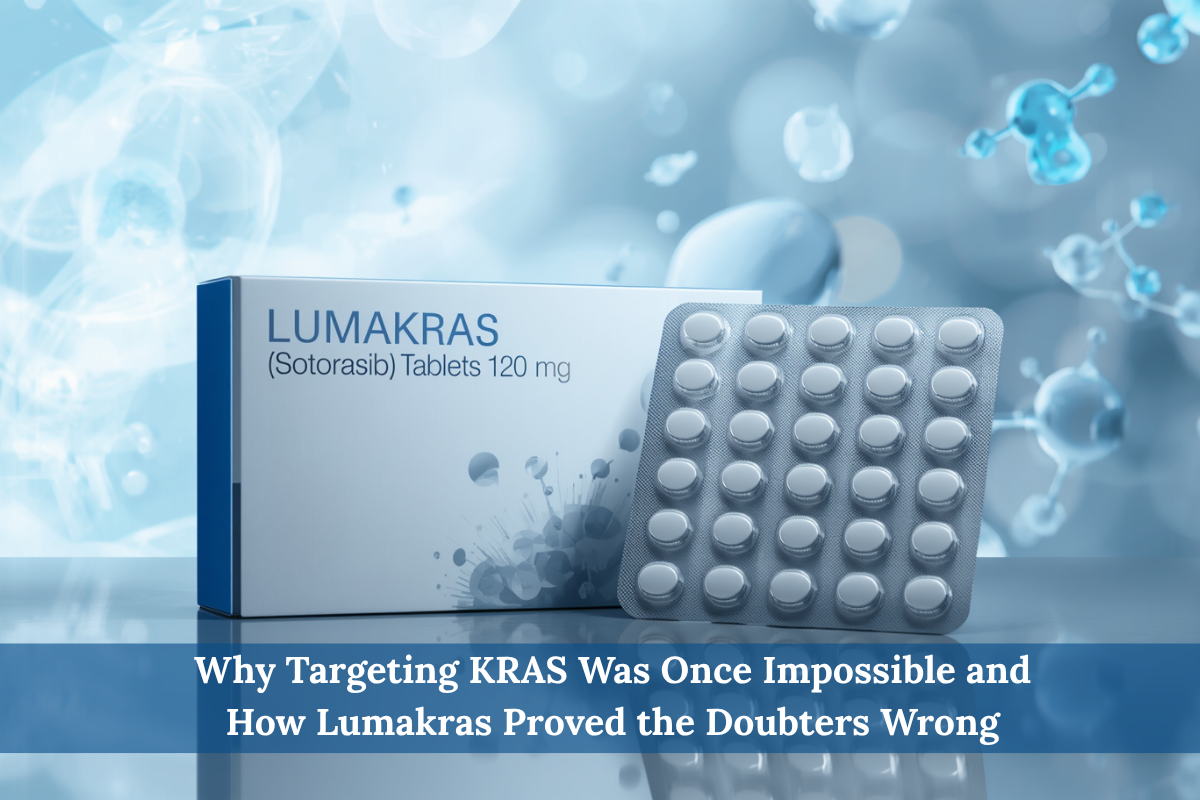
Targeting Kirsten rat sarcoma proto-oncogene (KRAS) G12C mutation has been challenging for decades. However, this perception evolved over time following the discovery of Lumakras. This article explores the journey of how Lumakras (Sotorasib) targets KRAS, while helping patients understand regulated access pathways such as how to buy lumakras tablets online in India.
Importance of KRAS
- KRAS is a type of gene that produces a protein which is actively involved in cell signalling channels. This is mainly responsible for cell growth, differentiation and its survival.
- This is most commonly found in Non-small Cell Lung Cancer (NSCLC) and metastatic colorectal cancer (mCLC), and patients often search for Sotorasib online in India to understand treatment availability.
- It works like a molecular switch during the normal cell cycle but it is always in its ‘On mode’ during its mutations resulting in excessive tumour growth.
Science behind the difficulty in targeting KRAS
- KRAS has a smooth surface and has no zones for binding with the drugs.
- It binds very tightly to the GTP/GDP molecules i.e., the body switches between cell growth signals ON and OFF.
- This causes difficulty in binding drugs in order to target KRAS. So the initial phases of drug development were not successful assuming to be undruggable.
- Subsequently scientists have found loopholes in KRAS. They found a reactive cysteine residue (drug binding sites) in protein that could covalently bind to a particular site. This promotes specific targeting of mutant KRAS, leaving behind the normal KRAS unaffected, creating a possibility to attack only the mutant ones, while patients also evaluate Sotorasib price in India during treatment planning.
Patients looking for updated pricing, import support, and legal access pathways can also read Buy Sotorasib (Lumakras) 120 mg in India – Real Price & Access.
Introduction of Lumakras
- Lumakras is a KRAS G12C inhibitor which focuses mainly on targeting KRAS in its inactive form to prevent tumor growth signals at the source, leading many to explore buy Lumakras 120 mg in India as part of prescribed therapy.
- When the active ingredient, Sotorasib in Lumakras attaches to mutated KRAS, the signalling pathways such as MAPK pathway and PI3 pathway are prevented. This contributes to breaking the flow of passage of the message signals for the growth of cancer cells.
- The recommended dose of Lumakras is 960mg once daily taken in the oral form. Same dose is advised for patients with NSCLC as a single agent and in combination with panitumumab for the patients with metastatic colorectal cancer, and some may also look to buy Lumakras 120 mg tablet in India based on dosage. Readers interested in understanding treatment pricing, procurement processes, and patient access can also explore Sotorasib (Lumakras) 120 mg Price in India – Access Affordable Treatment.
CodeBreak 100
FDA has granted accelerated approval to Sotorasib based on CodeBreak 100 study. The total number of subject participants enrolled are 427 patients with advanced KRAS G12C-mutated solid tumors. Among them, 250 patients included NSCLC. All these patients received at least one prior systemic therapy except in the treatment naive NSCLC cohort.
The primary endpoint and secondary endpoints were Objective Response Rate (ORR) and duration of response (DOR) respectively. Results showed that ORR was 36% and median duration of response was 10 months. The treatment emergent adverse events were diarrhoea, musculoskeletal pain, nausea, fatigue, hepatotoxicity and cough. Serious symptoms like pneumonia and hepatotoxicity are also observed in more than 2% of patients, and individuals may review Sotorasib tablets price in India before making decisions.
The landmark development and approval of Lumakras (Sotorasib) is a significant advance for patients with KRAS G12C-mutated NSCLC, providing a new and long-awaited treatment option for a refractory population of lung cancer patients. The success of Lumakras is not just a drug story but rather a story of scientific persistence and innovation. For an in-depth look, contact 24/7QualityMeds