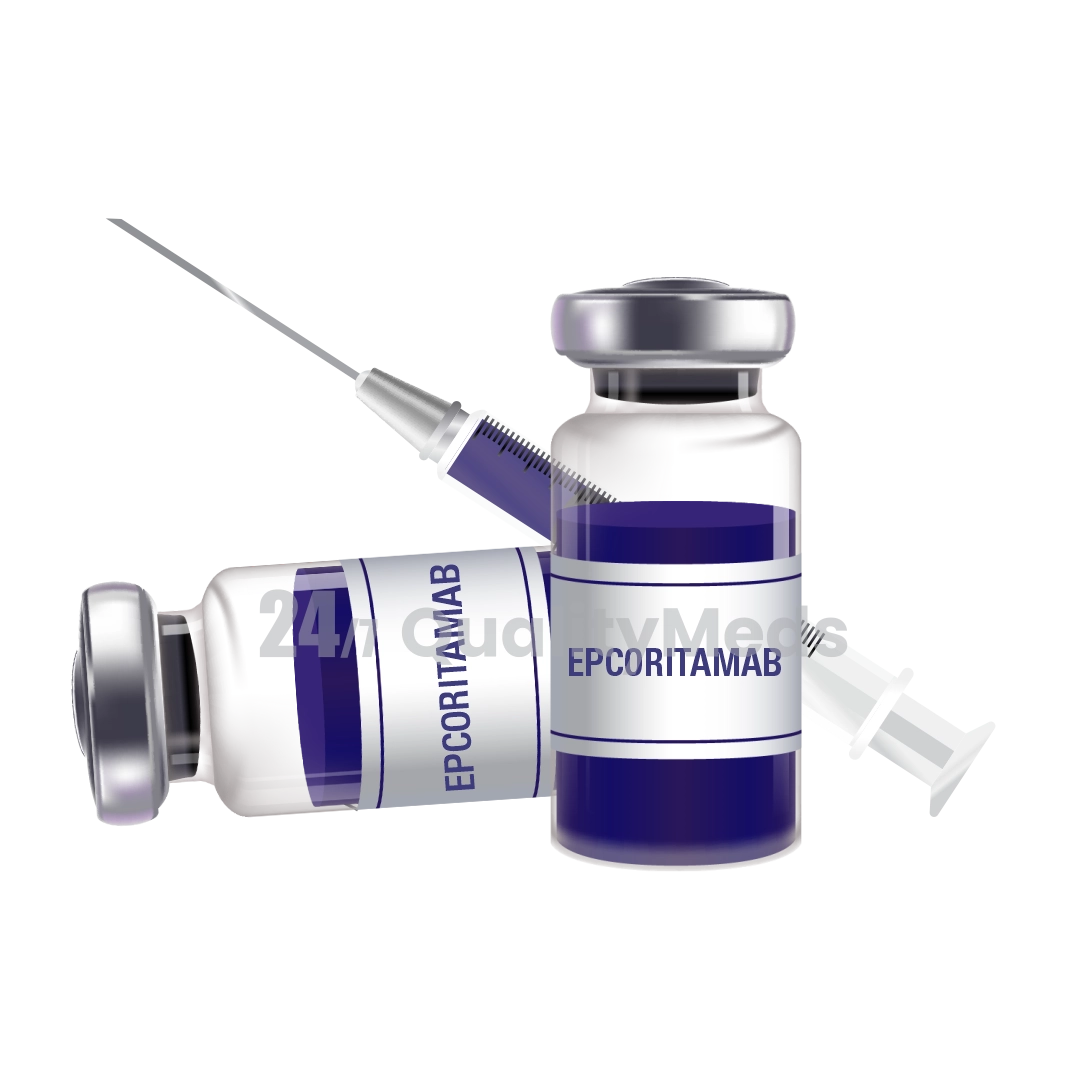
Tepkinly / Epkinly (Epcoritamab) is a bispecific CD20-directed CD3 T-cell engager indicated for the following:
- Treatment of adult patients with relapsed or refractory diffuse large B-cell lymphoma (DLBCL), not otherwise specified, including DLBCL arising from indolent lymphoma, and high-grade B-cell lymphoma after two or more lines of systemic therapy.
- In combination with lenalidomide and rituximab for the treatment of adult patients with relapsed or refractory follicular lymphoma (FL).
- As monotherapy for the treatment of adult patients with relapsed or refractory FL after two or more lines of systemic therapy.
Strength:
Injection: 4 mg/0.8 mL, 48 mg/0.8 mL in a single-dose vial.
Dosage:
DLBCL and High-grade B-cell Lymphoma
| Cyclea |
Day of treatment |
Dose of Tepkinly / Epkinly |
|
Cycle 1
|
1 |
Step-up dose 1 |
0.16 mg |
| 8 |
Step-up dose 2 |
0.8 mg |
| 15 |
First full dose |
48 mg |
| 22 |
48 mg |
| Cycles 2 and 3 |
1, 8, 15 and 22 |
48 mg |
| Cycles 4 to 9 |
1 and 15 |
48 mg |
| Cycle 10 and beyond |
1 and 15 |
48 mg |
aCycle = 28 days
Tepkinly / Epkinly as Monotherapy for FL
| Cyclea |
Day |
Dose of Tepkinly / Epkinly |
|
Cycle 1
|
1 |
Step-up dose 1 |
0.16 mg |
| 8 |
Step-up dose 2 |
0.8 mg |
| 15 |
Step-up dose 3 |
3 mg |
| 22 |
First full dose |
48 mg |
| Cycles 2 and 3 |
1, 8, 15 and 22 |
48 mg |
| Cycles 4 to 9 |
1 and 15 |
48 mg |
| Cycle 10 and beyond |
1 and 15 |
48 mg |
aCycle = 28 days
Tepkinly / Epkinly in combination with Lenalidomide and Rituximab for FL
| Cyclea |
Day |
Dose of Tepkinly / Epkinly |
|
Cycle 1
|
1 |
Step-up dose 1 |
0.16 mg |
| 8 |
Step-up dose 2 |
0.8 mg |
| 15 |
Step-up dose 3 |
3 mg |
| 22 |
First full dose |
48 mg |
| Cycles 2 and 3 |
1, 8, 15 and 22 |
48 mg |
| Cycles 4 to 12 |
1 |
48 mg |
aCycle = 28 days
Adverse effects:
- Cytokine Release Syndrome (CRS)
- Injection site reactions,
- Fatigue, musculoskeletal pain,
- Fever,
- Diarrhea
- COVID-19
- Rash
- Abdominal pain.
Storage:
Store refrigerated at 2°C to 8°C (36°F to 46°F). Keep in the original carton to protect from light. Do not freeze. Do not shake.
Cytokine Release Syndrome (CRS): The most common symptoms of CRS are pyrexia, hypotension, hypoxia, dyspnea, chills, and tachycardia. Concurrent neurological adverse reactions included headache, confusional state, tremors, dizziness, and ataxia.
Immune Effector Cell-Associated Neurotoxicity Syndrome (ICANS): The most common symptoms of ICANS are confusional state, lethargy, tremor, dysgraphia, aphasia, and non-convulsive status epilepticus. ICANS are not limited to these symptoms alone.
Infections: Epkinly can cause infections such as pneumonia, COVID-19, opportunistic infections and upper respiratory infections. The most common opportunistic infections of any grade were Cytomegalovirus (CMV) infection and herpesvirus infection.
Cytopenias: Epkinly can cause serious or severe cytopenias, including neutropenia, lymphopenia, anemia, and thrombocytopenia.